Contents
- The short answer: Companies House does not publish email addresses
- What the registered email address is, and who sees it
- What the Companies House register does show
- Where company email addresses actually come from
- How to find a company email address using Companies House
- The rules on emailing the address you find
- A checklist before you email a business you found on the register
- Honest limits
- Where Adapt Leads fits
Can you get a company email address from Companies House?
No. Companies House holds a registered email address for every company that has complied with the March 2024 rule, but it does not publish it on the public register or through its API. Use the register to confirm the company and its number. Then find the email on the company's own website or another public source and check it before you send.
- Companies House does not publish email addresses; the registered email address required since March 2024 stays private.
- The free register shows name, number, registered office, officers, SIC codes and filings. Use these to identify the company.
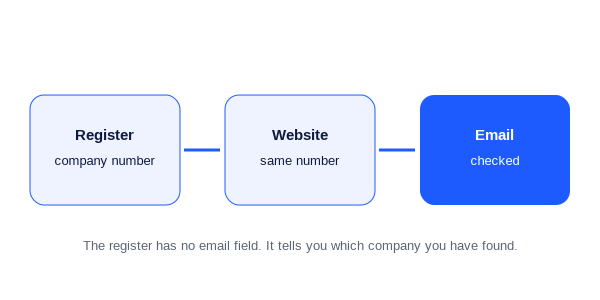
- Find the email on the company's own website and match the company number in the footer to the register.
- Before you send, check the address with a mail server test, record where you found it, and follow PECR and UK GDPR.
The short answer: Companies House does not publish email addresses
You cannot get a company's email address from Companies House. Since March 2024 companies have had to give Companies House a registered email address, yet the email address will not be published on the public register. Companies House keeps it for its own contact with the company.
The register is still useful. It gives you the company's legal name, number, registered office, officers and filing history at no charge. Use those details to find the right email elsewhere and check that it belongs to the business you have in mind.
This guide covers what the register shows, why the email stays private, where business email addresses appear, and the UK rules on using them.
What the registered email address is, and who sees it
A change to UK company law introduced the duty. Companies House explained that from 4 March 2024, new companies give a registered email address when they incorporate. Existing companies add one when they file their next confirmation statement with a statement date from 5 March 2024.
Gov.uk sets out the rule in three lines. A company must provide an email address and read the emails it receives. The address will not go on the public register. Companies House may use it to contact the company.
For each company that has complied, Companies House holds an address. You will not see it on a company page, in a downloaded document list or through the public API. It is a private line between the registrar and the company, never intended as a sales contact.
Why people expect to find it
Searches for "companies house email" tend to come from three groups:
- company owners looking for the email address Companies House holds for them, or how to change it
- people who want to contact Companies House itself
- sellers and recruiters hoping the register lists a contact email for other businesses
This article is for the third group. Company owners manage their own registered email address through their Companies House account.
What the Companies House register does show
Through the free search service, Find and update company information, Companies House makes all of the public data it holds on companies available free of charge. You do not need to register to look. For each company you can see:
- company name, number and status
- registered office address
- nature of business, shown as SIC codes
- current and resigned officers
- filing history, with free document images
- accounts and confirmation statement dates
- previous names, charges and insolvency information
To find a company, you can search the register by company name, number or officer name. An email address is not on that list, and no field on the public record holds one.
The Companies House API
Developers can read the same data by machine. The official listing says the Companies House API gives access to all of the public data it holds on companies free of charge. Access requires an API key, which you get by registering an application on the Developer Hub. The documented limit is 600 requests within a five-minute period; exceed it and you get an error until the window resets.
Because the API mirrors the public register, it has no email field either. Any tool that claims to pull emails "from Companies House" is getting them elsewhere and joining them to the register.
Where company email addresses actually come from
A business email you can use usually comes from one of these places:
- The company's own website. Contact pages, team pages and privacy notices often list an address. Many sites also print the company number in the footer.
- Letters, invoices and order forms. Anything the company sends you may carry a contact email.
- Trade directories and supplier listings. A business listed by its accountant's software provider, a trade body or a local directory often has a published email.
- A pattern guessed from the domain. With the director's name and the company's website, you can try common formats. A guess remains a guess until a mail server accepts it.
- A B2B data provider. These firms join register data to emails found in the places above, then check them.
In each case, the register tells you which company you are dealing with, so you can match a website or listing to the right legal entity.
The company number is the link
Gov.uk says a limited company must show its name, registered number, registered office address and place of registration on its documents, letters, order forms and websites. That gives you a reliable check. A website footer showing the same company number as the register tells you that the site, and the email on it, belongs to that company.
Names alone can be misleading. Two firms called "Smith and Co" can trade in the same town. The number tells them apart.
How to find a company email address using Companies House
Work through these steps to use the register properly.
Step 1: Confirm the company on the register
Search by name and open the company page. Note the company number, status and registered office. A dissolved or in-liquidation status is a reason to stop: there may be nobody to talk to.
Step 2: Note who runs it
On the officers tab, write down the current directors and their roles. Resigned officers are listed too, so check the dates before you address anyone.
Step 3: Find the website
Search for the company name plus its town or postcode. Check the footer or legal page for a company number. A match with the register confirms you have the right site.
Step 4: Collect the published email
Look on the contact, team and privacy pages. A generic address such as info@ or hello@ reaches the business. A named address reaches a person, which brings in extra rules covered below.
Step 5: Check the address before you send
Before adding the address to a campaign, run it through a mail server check. The server will accept it, reject it, or accept everything because it is a catch-all. Our guide on what a verified email really means explains each answer and its limits.
Step 6: Record where you found it
Keep the source and the date next to each address. You can then tell anyone who asks where you got their details. The date also tells you when an address is old enough to recheck.
The rules on emailing the address you find
Finding an email is one thing; the law on using it is another. Under the Privacy and Electronic Communications Regulations (PECR), the ICO separates recipients into two groups.
Corporate subscribers. Companies, limited liability partnerships, Scottish partnerships and some government bodies are corporate bodies with separate legal status. The ICO says the PECR rule on direct marketing by electronic mail does not apply to corporate subscribers. You can email them without prior consent.
Individual subscribers. Sole traders and some partnerships are treated as individuals and get greater protection. Before sending marketing email, you need their specific consent, or the soft opt-in for existing customers.
Every marketing email carries two duties. You must not disguise or conceal who you are, and you must give a valid address so the business can opt out.
Named people at a company
An address like jane.smith@company.co.uk identifies a person, so it is personal data. UK GDPR applies alongside PECR, including the right to object to direct marketing. The ICO calls that right absolute: if someone objects, you stop, with no exceptions. Keep a do-not-email list and check it before each send.
For a fuller walk-through of companies, sole traders and partnerships, read cold email in the UK: companies, sole traders and PECR.
A checklist before you email a business you found on the register
- ☐ The company is active on the register.
- ☐ You know its legal form: company, LLP, partnership or sole trader.
- ☐ The website shows the same company number as the register.
- ☐ The email came from a public source, and you recorded where and when.
- ☐ A mail server check has given you a result, and you know what a catch-all result means.
- ☐ Your email names your business and gives a working way to opt out.
- ☐ The address is not on your do-not-email list.
- ☐ For a sole trader or individual partnership, you have consent or a soft opt-in.
For a whole list, not just one business, the UK prospect list audit runs through the same questions.
Honest limits
Before you plan a campaign around the register, keep these limits in mind.
- Coverage differs by legal form. Sole traders and ordinary partnerships are not registered companies, so the company register will not list them.
- Not every company has a website. Many small companies trade without one, and some websites list no email.
- Directors change. The register shows appointments and resignations as they are filed, so check the dates and confirm on the company's own site.
- A mail server check is not proof of a reader. A catch-all server accepts every address, so the check cannot confirm one way or the other. Before discarding those addresses, read catch-all servers explained.
- Published does not mean free to use for anything. The ICO rules above still apply to a public address.
Where Adapt Leads fits
Checking one company at a time works for a short list. Across a sector or region, it gets slow.
The UK book in Adapt Leads starts from the same public registers, including Companies House, and adds licensed business data. Records are matched to the official register by company number where one exists. The book also holds sole traders, partnerships and shops that never appear on the company register. Each email carries a label from the mail server check: Verified, Catch-all server, No answer or Will not deliver. On every record, each field shows when it was last checked, and a website is marked as proven when it shows the company's number.
Every plan includes unlimited search and filters, and you can start free for 7 days with no card.
Company data
Questions about Companies House and email
Does Companies House give out company email addresses?
No. Companies must give Companies House a registered email address, but gov.uk states that it will not be published on the public register. Companies House uses it to contact the company.
When did companies have to give Companies House an email address?
From 4 March 2024, new companies have given one at incorporation. Existing companies give one with their next confirmation statement dated from 5 March 2024, as Companies House explained.
Can I see a company's registered email address through the API?
No. The Companies House API returns the same public data as the register. That does not include the registered email address.
Is the Companies House API free?
Yes. The official listing says it gives access to all public company data free of charge. You need an API key, and the documented limit is 600 requests in five minutes.
How do I find a company's email address if Companies House does not show it?
First, confirm the company and its number on the register. Find its website and check that the company number in the footer matches. Then collect the email from the contact or team page and check it with a mail server test.
Can I email a limited company without consent?
Under PECR, yes. The ICO says the email marketing rule does not apply to corporate subscribers. You must still say who you are and give a way to opt out. UK GDPR also applies if the address names a person.
Is a sole trader treated the same as a company?
No. Sole traders and some partnerships are individual subscribers under PECR. Before sending marketing email, you need their consent, or a soft opt-in as an existing customer.
How do I change my own company's registered email address?
You manage it through Companies House, not through the public register. This article covers finding other companies' emails, so check gov.uk for the current steps.
Where does Adapt Leads get its email addresses?
From public UK business registries, Companies House and licensed business data. These are merged into one record per business and rechecked. Each email shows its mail server result and when it was last checked.
Build a list with the evidence in view
Use the register to confirm who a company is, then check the email before you act.
Explore the UK business bookTalk to us
About the author
Jessica GardnerIn-house Editor, Adapt LeadsJessica writes Adapt Leads articles and guides on UK business data, prospect research and sales conversations.