Who sells to hair and beauty businesses?
A salon is a small shop that runs on appointments. Clients book a person as much as a place, so the stylist, barber or therapist matters to the business more than the premises do. Almost everything the business buys supports that appointment: colour and treatment products, tools, towels, furniture, software for the diary, card payments and insurance.
That makes salons a market for a very wide group of sellers. Product brands and wholesalers sell the colour, care and nail ranges. Equipment firms sell chairs, basins, lights and sunbeds. Software firms sell booking, till and client-record systems. Training providers sell courses, finance and insurance firms sell to the owner, and marketing firms sell to anyone who wants a fuller diary.
The sector is also unusually varied in how it is organised. A single owner-stylist, a barber with three chairs, a clinic run by a nurse and a regional chain all count as hair and beauty, and they buy in different ways. The work starts by deciding which of them you actually want to reach.
Why are salons hard to sell to?
Salon owners are rarely at a desk. They are on their feet with a client, so a call at eleven on a Saturday is a call they cannot take, and an email may wait days. Many also already have a favourite brand, a rep they like and a wholesaler they trust, and none of those change because of a cold message.
The decision-maker is also harder to spot than it looks. In an independent salon it is usually the owner, who may be the person cutting hair. In a chain it is a head office team or an area manager. In a clinic it may be the clinical lead or the practitioner who owns the business. A stylist who rents a chair often buys their own products, so a pitch aimed at the salon never reaches them.
Finally, the front door is built for clients. The phone number goes to the diary, the email address is a booking inbox, and the website is a menu of treatments. The person you need is usually reachable through the owner or through the social accounts they use to attract clients.
The owner decides
- You approach the owner
- A trial or sample
- Reorder through a rep or wholesaler
- Added to the back bar
Often decided in a few conversations, usually outside appointment hours.
Head office sets the range
- You approach the group
- Head office buying or operations
- Supplier checks and approval
- Salons order from the list
A salon manager can ask for a product but rarely lists it alone.
The practitioner decides
- You reach the individual
- They assess suitability and training requirements
- They buy it themselves
- Review before reordering
They pay for stock and tools out of their own pocket, so cost and results matter to them directly.
How is the hair and beauty sector put together?
Think of four broad kinds of business. Hair salons and barbers cut, colour and style. Beauty salons and nail bars offer facials, waxing, lashes, nails and similar treatments. Aesthetics clinics offer cosmetic treatments, some of them run by nurses, doctors or dentists and some by trained practitioners without a clinical background. Tanning studios sell sunbed and spray tanning, often alongside other services.
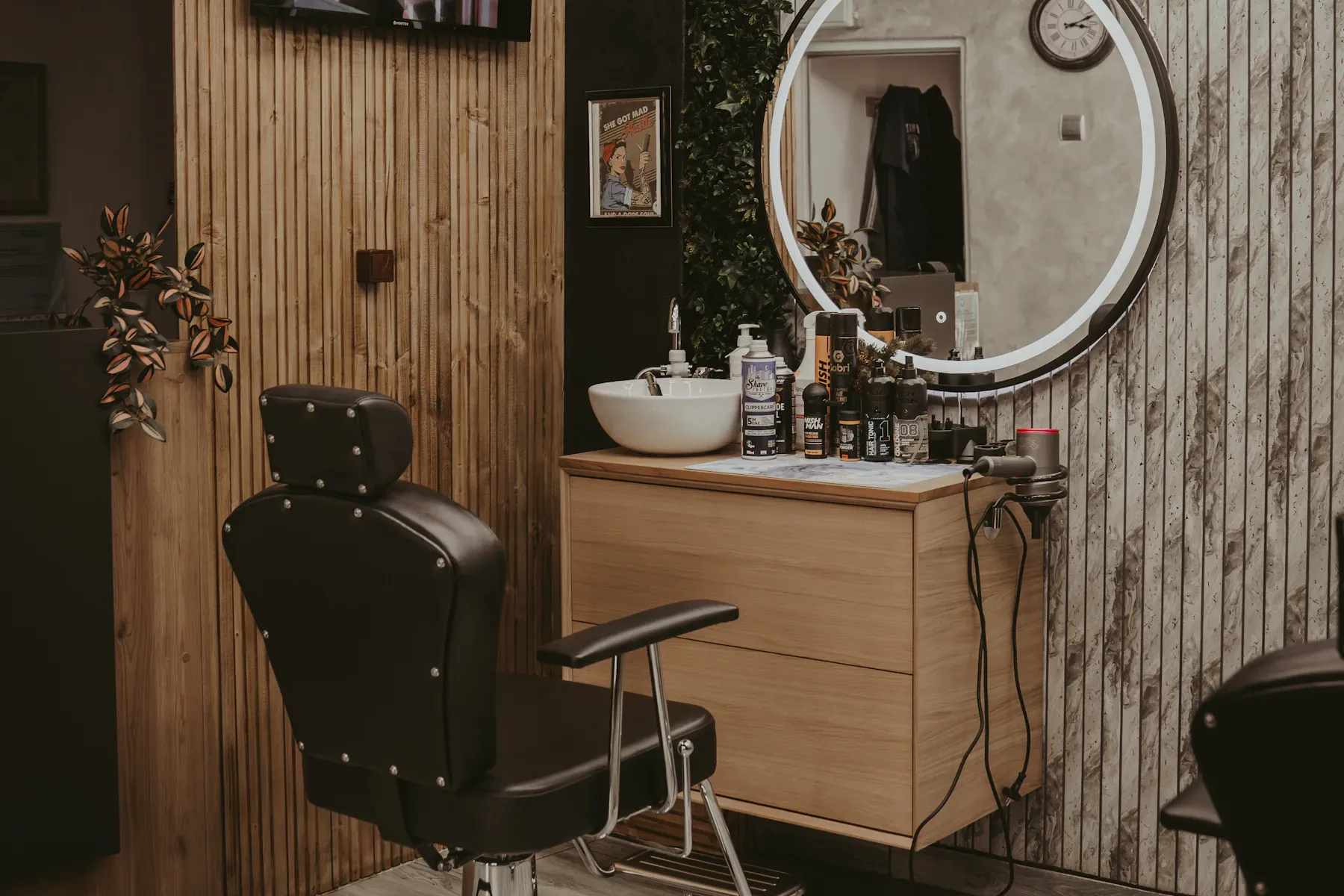
Alongside the premises sit the people who work inside them. Employed staff follow the salon's rules. Self-employed practitioners rent a chair, a booth or a treatment room, set their own prices and keep their own client lists, and HMRC publishes guidance on how to check employment status in hair and beauty. Mobile stylists and therapists have no premises at all and work from clients' homes or their own.
Most products reach salons through professional wholesalers and distributors, brand representatives and, for the larger names, brand education days where stylists learn techniques and see new ranges. Trade-only chains such as Salon Services sell to professionals on a trade card. The industry's big autumn gathering, Salon International, runs at ExCeL London alongside Professional Beauty London, and is where many brands meet salon owners.
Trade bodies include the National Hair and Beauty Federation, which supports members across hair, beauty, barbering and aesthetics and lists assured suppliers. The Hair and Barber Council runs a voluntary register of hairdressers and barbers. Both limited companies and sole traders are common here, and under PECR, the UK's rules for electronic marketing, a limited company counts as a corporate subscriber and a sole trader counts as an individual.
Counts as a corporate subscriber
You can send a relevant business email without asking first, as long as you say who you are and give an easy way to opt out.
Counts as an individual
A cold marketing email needs their consent first. Partnerships in Scotland are the exception: they count as corporate subscribers.
Are salon limited companies and sole traders both in the list?
Yes, both. The UK book holds hair and beauty businesses across several legal forms: limited companies, partnerships and sole traders. Chains and larger salons are usually limited companies. Many barbers, nail technicians, therapists and stylists work for themselves, as sole traders or as limited companies of one, and they sit in the same sector as the bigger names.
The two behave differently for a supplier. A limited company has directors and a registered address on the public register, so the list can show who runs it. A sole trader has one decision maker, who may trade under a salon name that is not their own and may rent a chair inside someone else's premises. The legal form we hold is shown on every record, so you always know which kind you are reading.
If you want only one kind, filter for it. A supplier of salon furniture may want limited companies with several chairs. A supplier of small-batch nail or lash products may do better with individual practitioners. Sole traders are harder to count than companies because there is no single public UK register of them, so treat the list as a strong start, not a full census of everyone who works in the sector.
What happens if you pitch the wrong person?
Time is the first cost. A message to a salon's general inbox may be read by a receptionist who cannot order anything. A call to a stylist who rents a chair may be heard as a sales call to the salon, which is not theirs to approve. A head office buyer may never see a pitch that began at the shop.
A change of product can require training, safety checks and time to evaluate how it is used. Ask what the practitioner would need to assess before considering an order. Include the relevant product instructions, costs and training requirements so a sample does not create extra work with no agreed purpose.
Pitching the salon when the stylist buys
A chair renter pays for their own products. Ask who buys before you choose the message.
Ringing in the middle of the day
Appointments run the day. Ask when the owner is free, or send a short message they can answer between clients.
Emailing a sole trader without consent
Many stylists and therapists are sole traders, who count as individuals under PECR. Check the label on the record before you write.
Who decides what a salon buys?
It depends on the size of the business and on what you sell. For products used on clients, start with whoever runs the colour or treatment menu. For the premises and the systems, start with the owner or director. In a group, start at the centre.
Company records can show directors where held, with the main contact marked where we can tell. In an owner-run salon that director is often the person you want. Salon managers, senior stylists and clinic leads are often not directors, so use the director as the way in and ask who looks after buying.
Owner or director
- What they care about
- A full diary, clients who return, margin on products, and not losing a good stylist.
- Open with
- One specific thing their clients ask for that is hard to get.
Salon manager
- What they care about
- Running the floor, stock on the shelf and keeping staff booked.
- Open with
- A way to cut waiting or stock-outs, offered as something they can recommend upward.
Head office or area manager
- What they care about
- Consistent range, supplier approval, cost across every site and brand standards.
- Open with
- Evidence from a trial and terms that make a pilot in a few salons easy.
Clinical lead or practitioner-owner
- What they care about
- Client safety, qualifications, insurance and the reputation of the clinic.
- Open with
- Clear product information and training, and no claim you cannot document.
Self-employed stylist or therapist
- What they care about
- What each product costs per client, quick results and not tying up cash in stock.
- Open with
- A small trial pack or a clear price per treatment.
How do you find hair and beauty businesses in the UK?
Start with the sector, then narrow by place. In the UK book, choose Hair & Beauty, which covers hairdressers, barbers, beauty salons and nail bars. Add the postcode areas you deliver to, or the region your reps cover. Spas and wellness centres, and tattoo and piercing studios, sit in their own sectors, so add them if they fit what you sell.
Filter for the information available, such as a named director, business phone or checked email. Check the salon’s current treatment menu and purchasing arrangements alongside company details. A register change does not show that a new range is needed. Search is free on every plan, with counts updating as you filter.
If you only sell to one kind of business, use SIC codes as well. Many hairdressers and beauty salons register under 96020, hairdressing and other beauty treatment. Tanning studios and wellness businesses may file under 96040, physical well-being activities, or under another code, because each business chooses its own. Search by sector first, then narrow by code. Records without a code still carry a plain-English sector.
Choose Hair & Beauty and your area. Searching is free on every plan.
What should you say to a salon owner?
First check that the salon offers the treatment your product supports. Ask who selects the range: the owner, a treatment lead, a group buyer or an independent practitioner renting space. That keeps the discussion relevant and gives the salon an easy way to explain what it buys.
Ask how the range is chosen and reviewed. If the salon has announced a new treatment room, confirm its plans before suggesting products. Be specific about intended use, training, order sizes and product evidence. Use a customer example only when it is accurate and you have permission to share it.
If the practitioner describes delayed stock, ask which products are affected and what happens to booked treatments. Explore whether an alternative can be used or appointments have to move. Then ask what supply arrangements would help, and what a trial would need to establish about suitability as well as delivery.
What clients ask for
Ask which products or treatments clients request that the salon cannot easily offer yet.
A quicker day
Ask where the day loses time, such as late cancellations, stock-outs or a clumsy booking process.
A confirmed treatment launch
Check the announced service and who is preparing it. Ask about product selection and training rather than assuming a new director means new treatments.
Hi Maya,
We supply professional nail and lash products in small trial sizes.
Does Wrenfield offer those treatments, and who chooses the products if so?
If the range is relevant, I can send trade prices, product information and training requirements before you consider samples.
Jo
Chain, independent salon or self-employed practitioner: what changes?
The same product needs a different approach depending on who buys. This is how the three kinds of buyer usually differ. Individual businesses vary, so use it to prepare your questions rather than to predict the answers.
| Chain or group | Independent salon | Chair renter or mobile | |
|---|---|---|---|
| Who decides what is bought | A head office or area team | The owner, often also a stylist | The practitioner, for their own work |
| What they ask for first | Supplier approval, product data and terms for many sites | Product suitability, safety information, training, price and availability | Cost per treatment and suitability for their work |
| How they buy | Through central agreements and approved suppliers | Wholesalers, reps, trade shows and brand education days | Wholesalers, trade cards and online |
| How long it can take | Usually longer, as the decision is central | Can be quick when a client need is clear | Often the same day |
| Where a pitch can stall | At the salon, which cannot list products alone | In the diary, with no time to listen | Because it was aimed at the salon, not the individual |
| Consent for cold email | Usually limited companies | Limited company or sole trader, so check the label | Usually sole traders, so check the label |
| Best first contact | The buyer or operations lead for your category | The owner or managing director | The practitioner, using an appropriate marketing channel |
Before you approach any salon
- Trade prices and what margin a salon can expect on products it resells
- Product information and safety data, and any claims you are ready to evidence
- Training or education you offer, and whether it is free or paid
- Minimum order, delivery times and how salons can reorder
- An evaluation or sample option used within product instructions, qualifications and safety requirements
- Insurance and qualification requirements for any treatment you supply
- Plain terms for chair renters, who buy for themselves
- Proof of use: other salons nearby that already use you
Questions people ask about selling to hair and beauty businesses
Is there a database of hair and beauty businesses in the UK?
Yes. The UK book holds hairdressers, barbers, beauty salons and nail bars under the Hair & Beauty sector, from single-chair independents to branches of larger groups. Search it free by area and by what we hold, and reveal only the contacts you want.
Who buys for a hair salon?
In an independent salon it is usually the owner, who may also be a stylist. In a chain, a head office or area team agrees the range and salons order within it. Stylists who rent a chair buy their own products, so ask who pays before you plan your pitch.
How do salons buy their products?
Typically through professional wholesalers and distributors, brand representatives and trade-only chains, with brands often offering education days. Trade shows such as Salon International let owners see ranges in one place. Ask each salon how it buys and who it trusts.
Can I sell to salons through trade shows?
Yes. Salon International, held at ExCeL London alongside Professional Beauty London, is where many brands meet owners and stylists. Many salons also buy from reps and wholesalers between shows, so a show is one route, not the only one.
Are hairdressers and barbers regulated in the UK?
Practitioner registration under the Hairdressers (Registration) Act is voluntary. Hairdressers and barbers still have business, consumer protection and health and safety duties, and some councils require premises registration. Check the relevant council and current rules before describing a requirement to a salon.
What licences do beauty and aesthetics businesses need?
Requirements depend on the treatment, location and premises. Check the relevant council’s licensing guidance and the regulator for any healthcare activity involved. Purely cosmetic use and treatment of a medical condition can fall under different rules. Do not assume that every laser treatment needs the same registration.
Can I get a list of hair and beauty businesses that are sole traders?
Yes. The UK book includes sole traders and small partnerships as well as limited companies, and each record shows the legal form we hold. Filter by sector and form, then check the rules for emailing individuals before you write.
Can I email salons without consent?
You can send a relevant business email to a limited company or LLP without consent if you say who you are and offer an easy way to opt out. Sole traders and most partnerships count as individuals and need consent first. Each record in the UK book says which it is.
How do I reach stylists who rent a chair?
They are often self-employed and may not appear as a company at all. Reach them through the salon owner with their permission, through their public business profiles, or with a consented message to a sole trader. Do not assume the salon speaks for them.
Does the list include barbers and nail bars?
Yes. Barbers, nail bars, beauty salons and hairdressers are all included and each is labelled for the kind of business it is, so you can narrow to the type you sell to.
Can I search by SIC code?
Yes. Records carry the SIC 2007 codes from the register and a plain-English sector for businesses without one, so you can search by either. Salons often use the hairdressing and other beauty treatment code, but each business chooses its own.
Do I pay to search?
No. Search and filters are free on every plan. Your allowance is only used when you reveal a new contact, and one you have already revealed never counts again.
Sources for this guide
- HMRC: employment status in hair and beauty
- National Hair and Beauty Federation
- GOV.UK: tattoo, piercing and electrolysis registration
For marketing rules, see the ICO’s business-to-business marketing guidance. Sector codes can be checked in the Companies House SIC list.