Contents
How do UK marketing email rules differ for companies and sole traders?
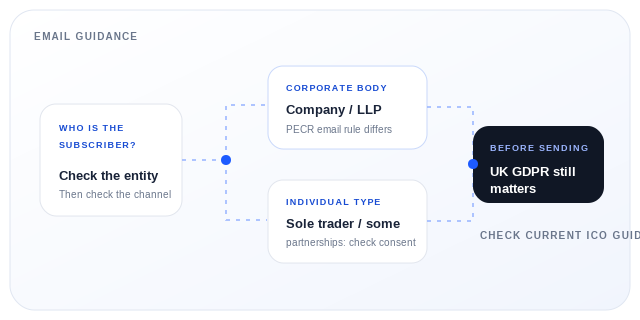
PECR distinguishes corporate subscribers from individual subscribers. Its consent requirement for unsolicited marketing email does not apply to corporate subscribers, while individual subscribers generally need consent unless an exception applies. Sole traders and some partnerships fall in the individual category. Sender identification and opt-out duties still matter, and UK GDPR applies when personal data is processed. The article links to the ICO guidance for the detailed conditions.
- A business email domain does not establish the subscriber’s legal type.
- A named work email can be personal data even when the employer is a company.
- An objection needs to remain visible in suppression records so the address is not reintroduced later.
This is a practical overview, not legal advice. UK email marketing rules depend on the recipient, the message and how personal data is used. Check the current ICO business-to-business marketing guidance before a campaign. The ICO says this guidance is under review following changes made by the Data (Use and Access) Act.
Two sets of rules may apply
PECR sets rules for direct marketing by electronic mail, including email and text. UK GDPR and the Data Protection Act apply when you process personal data, such as a named person's work email. The fact that an address is publicly available does not remove those data-protection responsibilities.
Identify the subscriber type
PECR distinguishes corporate subscribers from individual subscribers. Companies, limited liability partnerships, Scottish partnerships and other bodies with separate legal status can be corporate subscribers. Sole traders and some partnerships are individual subscribers.
For unsolicited marketing email, PECR's consent requirement does not apply to corporate subscribers. The sender still needs to identify themselves and provide a working way to opt out. UK GDPR may also require a lawful basis, transparency and respect for objections when the message uses personal data.
For individual subscribers, PECR generally requires prior consent for unsolicited marketing email unless an exception such as the soft opt-in applies and every condition is met. Do not assume an exception applies based only on the fact that the contact is a business.
Check before sending
- Confirm whether the subscriber is corporate or individual; do not infer it from an email domain alone.
- Check the current PECR and ICO guidance for the channel and message.
- Identify a lawful basis and provide privacy information when you process personal data.
- Say who you are and make it straightforward to object or opt out.
- Keep suppression records so people who object are not contacted again.
Calls have different checks
Live and automated marketing calls have their own PECR rules. Check the relevant Telephone Preference Service or Corporate Telephone Preference Service requirements and any previous objection before calling. Do not assume the email rules answer the call question.
What contact data can and cannot do
Adapt Leads shows company and contact details with field labels so a team can understand what it is looking at. It does not decide whether the sender may contact a person. The sender needs to check the recipient, purpose, channel and current rules for each campaign.
Email guidance
UK B2B email questions
Can I send unsolicited marketing email to a UK company?
PECR’s email consent requirement does not apply to corporate subscribers, but other duties still apply. Check UK GDPR, the message, your lawful basis and the current ICO guidance.
Can I send marketing email to a sole trader?
Sole traders are individual subscribers under PECR. Prior consent is generally required unless a specific exception applies and all its conditions are met. Check current guidance before sending.
Does UK GDPR apply to a named work email?
If you process personal data such as a named person’s work email, UK GDPR may apply even in a business-to-business context. Check your lawful basis, transparency duties and the person’s rights.
Is a company filing permission to email someone?
No. A public filing can inform research, but it is not permission to send marketing. Check the recipient type, purpose and channel rules.
Build a list with the business type in view
Use company information to research who you are contacting, then make the sender-side checks before a campaign.
Explore the UK business bookTalk to us
About the author
Jessica GardnerIn-house Editor, Adapt LeadsJessica writes Adapt Leads articles and guides on UK business data, prospect research and sales conversations.