Contents
What makes a manageable LinkedIn outreach routine for a small team?
A manageable routine leaves time to research the people you approach, explain why a conversation could be relevant and respond properly to replies. Plan the work around that capacity rather than request volume alone. Replies can show whether the audience and message fit; increasing the queue does not fix an offer that is irrelevant to the recipient.
- A current role helps establish relevance; a job title alone does not explain why you chose someone.
- An accepted connection and an interested reply are different outcomes.
- Following up on what the person actually said is more useful than continuing an unrelated sequence.
More connection requests do not automatically create more conversations. A small team gets further when it knows why each person belongs on the list and can explain the reason for connecting in one sentence.
Research before you connect
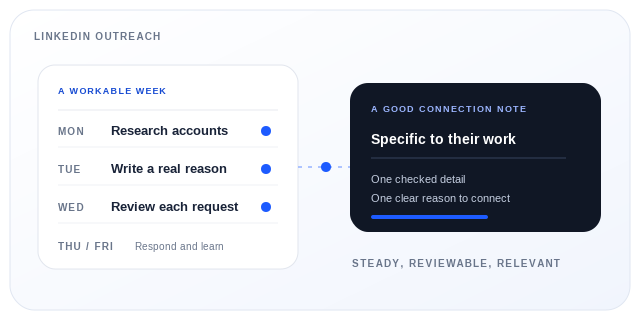
Check the company, the person's current role and the work they are responsible for. Look for a genuine point of relevance: a market they serve, a team they are building or a problem your product can address. A title alone is not a reason to send a request.
Write a real reason to connect
Keep the note short and specific. Say what prompted the request and why it may be useful to speak. Do not pretend you have met, claim to know the person's priorities or paste the same pitch into every invitation.
A useful check: Could the person understand why you chose them without opening a second message? If not, do another minute of research.
Keep a rhythm your team can review
Choose a modest volume that leaves enough time to check each profile, write a relevant note and respond to people who accept. Leave space in the week for follow-up and for improving the message. The right number depends on the team, audience and time available; a target is useful only if the quality stays high.
Follow the conversation, not a script
When someone replies, read what they said and respond to that. A connection is not consent to receive a sequence of unrelated pitches. If there is no response, pause and decide whether another contact route would be more useful than another nudge.
Learn from the replies
Look at the conversations that move forward. Which companies fit? Which reasons earned a thoughtful response? Which requests felt generic? Use those patterns to improve the next round of research and writing instead of simply increasing volume.
LinkedIn outreach
Building a LinkedIn outreach routine
How many LinkedIn requests should a small team send?
Choose a manageable target that leaves time to research each person and handle replies. There is no useful weekly number if the team cannot explain why each person is on the list.
What should a connection note say?
Use a real, specific reason for connecting and keep it easy to understand. Avoid a full product pitch or a claim about the person’s plans.
Should I follow up if someone does not reply?
Review the context first. A pause or a different, relevant channel may be more appropriate than sending repeated nudges.
What should I measure?
Track relevant conversations and replies alongside the quality of the target accounts. Request volume alone does not tell you whether the approach is working.
Make each connection worth accepting
Give your team a clearer view of the right UK companies and people to approach.
Explore the UK business bookTalk to us
About the author
Jessica GardnerIn-house Editor, Adapt LeadsJessica writes Adapt Leads articles and guides on UK business data, prospect research and sales conversations.