Contents
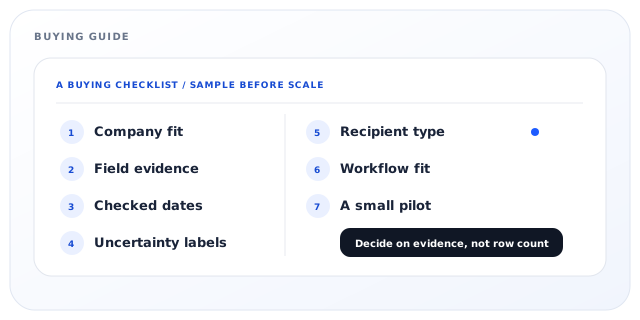
Before paying, inspect a representative sample. Check who each record describes, how each contact field is supported, when it was last checked, how uncertainty is labelled, which business types are included and how opt-outs are handled. Row count tells you volume. A sample tells you whether your team can use the data.
- Check company fit before comparing list size.
- Ask what supports each field and when it was checked.
- Confirm how uncertain values, business types and opt-outs are handled.
- Run a small test against your real workflow before buying more.
1. Start with the job the list must do
Write down what your team sells, which businesses can use it and who normally decides. “UK accountants” is a market label. “Independent accountancy practices with a team of five to twenty people that need a managed IT provider” is closer to a search brief.
A contact list can be accurate and still be wrong for your campaign. A real person at the wrong company is not a useful prospect. Agree the sectors, places, company sizes and roles that fit your offer before comparing providers.
2. Open a sample before you count rows
Pick a representative sample from the kinds of businesses you plan to reach. Check whether each business fits, whether the company and trading names match, and whether the person still has the role shown.
Look at edge cases too: a group with several branches, a sole trader, a company that has stopped trading or a firm with no named director. Ask the provider how those records are represented instead of assuming they all mean the same thing.
3. Ask how each field is supported
A single score for a whole record can hide important differences. The company name might match an official register while the phone number comes from an older directory. Ask what source or evidence supports each field, when it was checked and what happens when sources disagree.
Ask what labels such as Verified, Claimed or Catch-all mean in practice. For email, a server response is evidence about how that server answered at the time of the check. It does not prove the person still works there, that a message will reach the inbox or that they want to hear from you.
A useful provider explains uncertainty. If a value is missing or contested, you should be able to tell what needs another check.
4. Check dates and company changes
Ask when business and contact details are refreshed, and whether the last-checked date is visible on each field. One refresh date for an entire file is less useful than knowing when a phone number, email or appointment was last checked.
For registered companies, compare a sample with the Companies House register. It can help you check a company's status, filings and officers. It cannot tell you whether that business needs your product, so treat a change as a prompt for research rather than proof of buying intent.
5. Match the record to an appropriate contact route
Check which business type you are contacting and which channel you intend to use. PECR treats corporate and individual subscribers differently for electronic marketing. Sole traders and some partnerships are individual subscribers; companies, LLPs, Scottish partnerships and other bodies with separate legal status can be corporate subscribers. If you use a named person's details, UK GDPR also applies.
Ask how the provider distinguishes those records and what removal or suppression controls are available. The sender still needs to identify themselves, check the rules for the recipient and channel, and honour objections. The ICO's business-to-business guidance is under review following changes made by the Data (Use and Access) Act, so check the current version before sending.
6. Make sure the data fits your workflow
Can the team filter by the fields that matter? Can it see why a record matched? Can it save or export a useful subset and keep objections out of future campaigns? Ask about access, export limits, updates and how a record is removed, not just the headline price.
Then try the list in the actual workflow. Give one salesperson the brief and ask them to choose a record, explain why it fits, find a relevant reason to contact and decide what to do next. If the record does not help them do that, a bigger list will not solve the problem.
7. Use a small test with clear pass criteria
Agree what the team will check before it starts: whether sampled businesses fit your target, whether important fields have useful evidence and whether an export reaches the CRM in the shape you need. Choose a sample size that makes sense for your team and budget; there is no universal number that proves a list is good.
Do not judge data quality on replies alone. The offer, timing, message and audience also affect replies. Use the test to find data problems and workflow friction, then decide whether a larger plan is worth buying.
A useful buying question: “Can you show us what supports this field, when it was checked and what you do when you do not know?”
Buying guide
Choosing UK B2B contact data
Is a verified email guaranteed to be delivered?
No. A verification result records what a mail server said at the time of the check. It does not guarantee inbox placement, that the person still works there or that they will reply.
How many records should I sample?
There is no universal sample size. Choose enough records for your team to check the fields, business types and edge cases that matter to its planned use.
What should I compare between providers?
Compare coverage for your target, evidence and last-checked dates, how uncertain records are labelled, export and removal controls, and the time your team needs to turn a record into a relevant next step.
Does buying a list decide whether I can contact someone?
No. You still need to identify the recipient type, apply the rules for your channel, use personal data lawfully and honour objections.
Choose data your team can explain
Start with the businesses you can help, then check the evidence behind the fields your team will use.
Search the UK business bookTalk to us